Strategies for Gamma Sterilization of Pharmaceuticals
Sterility is desirable not only for medical devices, but also to ensure the safety of parenterals or injectable drugs. Various methods of reducing microbial load in drugs and parenterals are available.
by Ruth Garcia, Betty Howard, Rose LaRue, Glenn Parton, and John Walker
Steris Isomedix Services (Mentor, OH)
![]() |
| Steris� new JS 10,000 continuous and incremental Cobalt-60 irradiator is ready to process customers� products. |
A crucial step in pharmaceutical production is sterilization. There are many sterilization methods to choose from, such as steam, sterile filtration, ethylene oxide gas (EtO), electron beam (E-beam), and gamma radiation. Each technique has aspects that make it suitable or unsuitable for the sterilization of a particular product.
For example, EtO, while being a highly effective method, leaves behind potentially hazardous residuals and cannot reach products in airtight packages. E-beam, while being one of the fastest methods of sterilization, cannot penetrate well into dense product or bulk packaging of some products. In addition, the product complexities of heterogeneous components often require extensive product qualification. Gamma radiation can cause certain product and package materials to degrade.

GAMMA BENEFITS
Gamma radiation does have some significant advantages over other methods of producing sterile product. These benefits include:
� Better assurance of product sterility than filtration and aseptic processing.
� No residue like EtO leaves behind.
� More penetrating than E-beam.
� Low-temperature process.
� Simple validation process.
The first aspect to consider when sterilizing with gamma is product tolerance to the radiation. During use of this type of radiation, high-energy photons bombard the product, causing electron displacement within. These reactions, in turn, generate free radicals, which aid in breaking chemical bonds. Disrupting microbial DNA renders any organisms that survive the process nonviable or unable to reproduce.
However, these high-energy reactions also have the potential to disrupt bonds within the pharmaceutical formulation, to weaken the strength of packaging materials, and to cause changes in color or odor in some materials. For these reasons, drug manufacturers should perform pre-qualification Dmax (maximum dose) testing, whereby the drug and its packaging are subjected to a high dose of gamma radiation and then evaluated for stability and functionality.
Usually, the manufacturer will be the party responsible for drug testing. Parameters to characterize typically include potency, efficacy, stability, biocompatibility, and chemical acceptability. Per guidelines under the International Conference on Harmonization (ICH), known as Technical Requirements for Registration of Pharmaceuticals for Human Use, it is recommended to use high-performance liquid chromatography (HPLC), mass spectrometry, or gas chromatography to characterize and compare different analytical aspects of irradiated product versus nonirradiated product.
A qualified laboratory should perform package testing. It is often recommended to have an aerosol challenge performed on the product and pack-aging. This test entails placing the packaged product inside an aerosol chamber and exposing it to high levels of bacterial spores. The product is then subjected to a sterility test, which shows whether or not the packaging maintains a sufficient barrier.
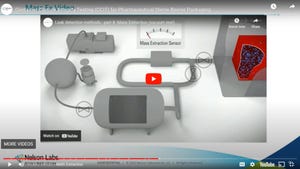
In addition, at least one physical challenge should be performed on the packaging, if applicable. These in-clude the peel test to determine the amount of pressure needed to open the seal; the burst test to determine the amount of pressure needed to burst the package and to locate areas of weakness in the package; and the dye migration test, which determines whether dye travels through the seals of the package. If a shelf-life claim is desired, most labs will perform accelerated aging. Typically, incubation at 55�C for 6.5 weeks equals one year on a shelf (this may vary depending on the drug formulation). These tests are performed on aged products.

Performing a fraction of or all of these tests following a high dose of gamma radiation will give the manufacturer a good idea of product and packaging suitability for gamma radiation. (A high dose is usually considered to be in the 50�60-kGy range or higher, preferably twice the minimum.) Many materials are highly resistant to radiation. If possible, the manufacturer should choose materials that are resistant to the effects of gamma prior to the initial production phases.

HANDLING DEGRADATION
If a drug experiences degradation, discoloration, or any other physical malady due to the high dose of 50�60 kGy, the manufacturer can begin testing at lower doses. One method involves testing at particular intervals, such as at 5 or 10 kGy. For example, a drug that fails at 50 kGy may be stable at 40 kGy.
However, some drugs may continue to exhibit effects from the radiation at extremely low doses. Another test entails dropping the dose to half of the original high dose. This would cut the range of possible maximum doses in half. If the product is stable at the new dose, then the max dose will fall somewhere within the top half of the original high dose. If the product is still showing instability, the max dose must fall in the lower half of the original high dose tested. This method may reduce the number of irradiations necessary for establishing this information. All in all, the end product of this testing should be a solid maximum tolerated dose for the particular drug product.
Many pharmaceutical products, including parenterals and orally ingested drug products, are composed largely of water. Water dissociates as a result of exposure to radiation and is a major source of free radicals. These free radicals can cause chemical compromise, so drugs with high water content often respond poorly to irradiation.
Performing irradiation on product in a frozen state can mitigate these effects. If the product can be safely frozen and thawed, the potential exists to irradiate it without, or with less, product degradation. Freezing the drug traps free radicals in the ice crystals, reducing their freedom to move about. This may induce them to recombine with each other, rather then disrupt molecules in the product itself. This would possibly improve drug resistance to degradation during gamma irradiation. Other options such as freeze-drying and/or using free-radical scavengers may also alleviate the degradation effects seen in some products.
FINDING THE RIGHT DOSE
The next step is to set the minimum sterilization dose, which will provide the desired sterility assurance level (SAL). There exist two commonly used, industry accepted, validation techniques, with several variations for special circumstances. The first technique for discussion, Method 1, is found in AAMI/ANSI/ISO 11137:1994, �Sterilization of Health Care Products: Requirements for Validation and Routine Control� Radiation Sterilization.�
Method 1 encompasses product with bioburden up to 1 million colony-forming units (CFUs). It allows for extremely low and high doses and is well known throughout the gamma sterilization industry. The steps are simple and straightforward. First of all, 10 product samples from each of three separate production batches must have bioburden testing performed on them. This quantitative measure, or count, of the number of organisms on the unsterilized product provides an excellent tool for determining the minimum dose necessary for sterilization.
Bioburden tests should be accompanied by a determination of recovery efficiency. This allows the laboratory to calculate a more accurate bioburden number. The average bioburden of each batch and the overall average of all product units should be determined. If any single-batch bioburden level is more than twice that of the overall bioburden, that batch average should be used. Otherwise, the overall average should be used.
Afterward, the verification or sublethal dose must be set. Using AAMI/ANSI/ISO 11137 Table B.1, find the bioburden number equal to or just higher than that of the product. Follow the row to the column labeled SAL 10�2, where the verification dose will be found.
The final phase includes testing for Bacteriostasis/Fungistasis (B/F) and setting the verification dose. The B/F test validates the sterility test by determining whether the product formulation inhibits bacterial or fungal growth. If inhibition is seen, steps must be taken to neutralize it. The test is required only once in the lifetime of a product, but it is recommended annually. Without such a test, sterility-testing results are meaningless.
To begin the verification dose experiment, send 103 product units (100 for sterility testing and 3 for B/F) to the sterilization provider for irradiation at the verification dose � 10%. If the dose exceeds the prescribed verification dose by more than 10%, then the product must be sacrificed and new product irradiated. If the dose is lower than 90% of the prescribed dose, the remainder of the testing may be performed and a failing test would allow for a retest.
The product should then be sent to the laboratory for sterility testing and B/F testing. If two or fewer sterility tests turn positive, the product has passed the validation, and the next step is to find the sterilization dose. Manufacturers should follow the same row in Table B.1 from which the verification dose was taken, to the column marked SAL 10�6. This is the minimum sterilization dose. The product now qualifies to be irradiated at a range from the minimum dose to the maximum dose determined during the high-dose materials testing.
The second type of validation is commonly known as VDmax. Found in AAMI TIR 27:2001, �Radiation Sterilization, Substantiation of 25 kGy,� this method requires fewer products and results in a minimum sterilization dose of 25 kGy. However, only products with 1000 CFU or less qualify.
The first step of this process is identical to that of Method 1. Bioburden data from 10 products from each of three separate production batches should be collected. Using Table 2 of the TIR, the bioburden number equal to or just greater than the product�s average bioburden is found. The sublethal dose is found by following the row to the column labeled �Verification dose� (SAL 10�1). Send 13 product units (10 for sterility testing and 3 for B/F) to the sterilizer for irradiation at the verification dose � 10%. Once the irradiation is complete, send the products to the laboratory for sterility testing. If one or fewer sterility tests turn positive, the product can be irradiated at a minimum dose of 25 kGy. If two positive sterility tests occur, a retest should be performed on 10 additional products. This time, no positives are allowed for substantiation of 25 kGy. Should positives occur, another dose-setting method must be used.
Also contained in AAMI 11137 is an alternative validation procedure referred to as Method 2. Method 2 provides for dose setting based on the actual radiation resistance of microorganisms as they naturally occur on a product. Of the methods cited, it can provide the lowest possible minimum dose. It is not used as frequently as Method 1 or VDmax, due to more sample requirements and associated costs.
Method 2 uses incremental dose data to select a verification dose. Groups of samples from three production batches are irradiated in dose increments up to the point where an SAL of 10�2 can be determined. A Method 2 validation starts with the random selection of 280 samples (Method 2A) or 260 samples (Method 2B) from each of three production batches of product. Samples are then designated in groups of 20 samples for each dose increment. Method 2A uses nine increments in 2-kGy increments, and 2B uses eight doses at 1-kGy increments. All samples are tested for sterility. After the results of sterility tests are known, a series of calculations described in AAMI 11137 (section B3.4.2) a verification dose (D*kGy) is determined.
An additional 100 samples from the batch designated from the initial sterility tests are irradiated at the verification dose and tested to confirm sterility. Following these sterility tests, a sterilization dose is calculated using the equation appropriate to the specific method chosen (2A or 2B).
In extreme circumstances in which all efforts to neutralize bacteriostatic agents have been exhausted and other sterilization methods are unsuitable, dose setting can be done with inoculation of the product. The practice of inoculation, commonly used in the past, is not currently recommended unless it is impossible to collect natural bioburden data from the product. Fortunately, in most cases, product inoculation is not necessary.
The organism most commonly used for radiation challenge is Bacillus pumilis. It was once believed that this organism was highly resistant to gamma. However, many organisms naturally occurring in medical products are more resistant to radiation than
B. pumilis, rendering this a poor surrogate organism. If no alternative exists, however, this method may be acceptable. A D10 value (D value) of an organism, in this case, is the amount of radiation (quantity of kGy) necessary to reduce the bioburden level by 1 log.
An example of a published D value for B. pumilis is 1.7 kGy. Some caution should be taken in using a published D value, as D values can vary depending on the technique used to determine them and/or the inoculation substrate. Also, D values, or the resistance of an organism to gamma radiation, can change over time, analogous to antibiotic resistance in microorganisms. However, if this is the method to be used, the following is an example of the calculation for determining minimum sterilization dose.
Inoculation with 106 (1,000,000 organisms):
SAL = 10�6
106 to 10�6 = 12 log reduction
D value 1.7 kGy � 12 log reduction
= 20.4 kGy
20.4 kGy = 10�6 SAL dose
The following calculation determines the necessary verification dose for 10 products to show the efficacy of the above 20.4-kGy sterilization dose:
Log bioburden � log (1/#samples)]
� d-value = verification dose
Log 1,000,000 � log (1/10)] � 1.7 =
verification dose
[6 � (�1)] � 1.7 = verification dose
[6 + 1] � 1.7 = verification dose
7 � 1.7 = verification dose
11.9 kGy = verification dose
A radiation dose of 11.9 kGy � 10% is applied to 10 product units, which are then sent to a lab for sterility testing. If no more than one test out of 10 turns positive, the sterilization dose, in this example, 20.4 kGy, is validated.
Finally, whichever method is used, the manufacturer must verify the dose every 3 months in an experiment known as a Quarterly Dose Audit. To do this, 10 samples must be sent to the laboratory for bioburden testing.
Furthermore, every organism cultured during the bioburden test should be identified, at minimum with a colony morphology and gram stain. Simultaneously, repeat the original verification dose experiment for whichever method was used during the original validation. For example, if Method 1 determined the original sterilization dose, then the Method 1 verification experiment must be repeated. The original verification dose, or a dose augmented from a past dose audit, is the dose that must be used.
The quarterly bioburden samples serve as a trend-analysis tool. A new verification dose should not be determined from new bioburden data. Should a product fail a dose audit, the bioburden data may hold valuable clues as to why the failure occurred, e.g., a spike in bioburden number or shift in organism types. If neither of these is the case, there is possibly an increase in the radiation resistance of the organisms.
A dose audit failure requires a dose augmentation. The augmentation amount is found in the dose-setting table used in the original validation. Beyond all of this, the dose audit should also include manufacturing environment monitoring, such as water testing, air sampling, and contact agar plates. Although regular environmental monitoring is recommended at shorter intervals, such testing quarterly meets the minimum requirements.
The AAMI dose-setting methods described here are only recommendations and do not exclude other dose-setting procedures that may be deemed more appropriate by their users. The AAMI methods are widely accepted in North America. When properly applied, they have been accepted by regulatory groups as valid dose-setting procedures.
AAMI guidelines are regularly reviewed and updated through collaboration by industry experts (the latest drafts under consideration are 11137-01, 02, and 03, which will encompass the methods cited here in 11137:1994 and TIR 27) and are designed to provide a guideline that encompasses the latest in industry knowledge and requirements.
Each method has advantages and disadvantages, and care must be used in selecting a method that best fits the needs and limitations of the product being evaluated. These methods can provide an acceptable and straightforward means of substantiating dose selection for pharmaceutical products.
Following this guidance will aid in the successful validation of any radiation-stable pharmaceutical product for gamma radiation sterilization. The ideal time for considering the method of sterilization is at the concept stage, so that gamma-compatible materials can be chosen and the effects on product safety and efficacy can be considered. With the variety of materials currently available, many pharmaceuticals and most packaging materials can satisfactorily withstand the rigors of gamma processing.
Steris Isomedix Services provides technical support during all of these processes, including research, turnkey validations, special projects, and technical information.