Control in Pharma Filling
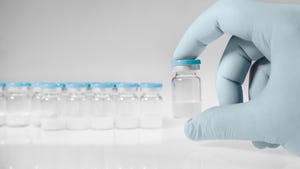
The pharmaceutical industry has seen a number of companies experience deficiencies in manufacturing and packaging operations, often calling product quality into question. For instance, glass particles were found in one company’s drug vials along with possible contamination of sterile drug products, according to a warning letter sent by FDA in August to the company.
Maintaining product quality is therefore on the minds of pharmaceutical packaging professionals as they seek new packaging equipment, including package filling systems.
Filler providers are therefore showcasing their abilities to ensure accuracy and control contamination, while meeting throughput demands. Following are a few recent innovations.
In-Line Liquid Filling Control
Oden Corp. (Tonawanda, NY) has introduced a new servo-controlled nozzle lowering system that allows nozzles to dive into a container within millimeters of the container bottom with servo-controlled repeatability and accuracy. The system is featured on its Pro/Fill 3000 Dual-Lane Liquid Filler, which enables quick changeover, easy product set-up, and precise servo-controlled repeatable nozzle positioning during filling. It offers rapid no-tool changeover as well.
| The LABBY from MG America can fill capsules with any powder. |
The machine can be used for filling a wide range of pharmaceutical products, Phyllis Phallen, vice president, marketing, for Oden Corp., tells PMP News. “The new nozzle-lowering system is electronically controlled, a distinct advantage over manual pneumatic controls, which must be laboriously adjusted for each product or volume change. Electronic control provides for recipe driven set-up entered via a computer screen, ensuring set-up parameters that are inherently repeatable. Finally, the nozzle-lowering system allows filling to within milliliters of the container bottom, a critical aspect for filling many pharmaceuticals, thereby expanding the product range accommodated by the filler.”


Designed for “no-drip” filling of foamy and non-foamy, low- to high-viscosity products, the filler provides a cost-effective means to filling a wide range of products and container sizes and offers increased output with its dual lane offset indexing system,
Phallen explains.
This system is also offered in Class 1, Division 1, Group D Explosion Proof configuration for use in hazardous environments.
Clean Tube Filling
Bernie Conlon, president, OYSTAR USA Pharmaceutical Packaging Division, says the biggest customer request by far across all tube filling markets is a drive toward clean in place (CIP). “If product contact parts are touched by operators, these parts are no longer sanitized,” he tells PMP News. “CIP or alternatively the opportunity to remove all contact parts in one piece (en bloc) minimize or eliminate operator touches, thereby reducing the risk of contamination.”
Cleaning time is becoming an important topic, especially with CIP applications, Conlon adds. “Let’s face it: when you are cleaning a machine, you are not producing. We’ve developed a revolutionary dosing system that will reduce CIP cycle times from hours to minutes. We’re very pleased with this new development and we will be exhibiting for the first time at PackExpo 2010.”
Quick changeover demands accessibility and manageability of format and contact parts, Conlon says. “Lighter parts that are easier to reach allow an operator to conduct the changes quickly and efficiently. Our machines do not require customization as they are designed specifically to meet these needs.”
Machine design and user SOPs (standard operating procedures) are both key to preventing cross contamination, Conlon explains. “The design features that we employ in preventing cross contamination are machines that are easy to clean with smooth surfaces and [without] threaded parts that can trap and hold product. Another source of contamination comes from the operators that clean the machine. For example, if you remove the contact parts, disassemble them, sanitize them, and then reassemble them, these parts are no longer sanitized due to human touches required in the reassembly process. That is why there is the need for CIP, which eliminates the risk of this type of contamination. Alternatively the contact parts can be removed en bloc, sanitized off line en bloc, and returned to the machine en bloc. This technique greatly reduces human contamination risk.”
OYSTAR has also developed a 100% in-process weight control system to automatically weigh every tube before it leaves the filler. “The big benefit here is that the system feeds back to the servo driven dosing pumps and automatically adjusts the fill volume should the product characteristics change.”
Pharmaceutical companies often “overfill tubes to make certain that no customer gets less product than what is printed on the tube,” he observes. “Because this system monitors and controls the dose amount, the system will allow the manufacturer to reduce the amount of the “overfill” and results in a significant cost savings. Let’s say this weight control system allows a pharmaceutical company to reduce the “overfills” by one gram per tube. If that company produces 30,000,000 tubes per year, the savings are extraordinary. This quality control option is also a money maker for the pharmaceutical company.”
100% Capsule Weight Control
MG America, the U.S. subsidiary of MG2 offers the LABBY, a modular, compact capsule filler with a small footprint. The fully automatic system can function in either continuous or intermittent mode, depending on the type of dosing unit installed.
The LABBY can be used to fill up to 3500 capsules per hour and can handle all powder, including API without excipients or bulking agents. It can achieve dosing weights from 0.5 to 20 mg, without compaction, through 100% net-dosage weight-checking.
A microweighing system enables the system to achieve 100% net product weighing, which results in system accuracy of ±0.1 mg of the net weight, depending on the target weight and product characteristics.
The LABBY can dose powder (dosators); low dosages of powder to be inhaled without compaction (dosators); micro dosages of powder without compaction (vibration); powder (tamping pin); pellets; tablets; universal tablet feeder; micro-tablets (counting); and capsule into capsule and liquids.
- Login or register to post comments
-
- Email this page
Printer-friendly version